The Control Room: Founding Ten | Publisher In a Box
Publisher In a Box · The Control Room

Everyone is selling you agents.
We hand you the architecture.
You build the Control Room that runs them.

A founding group of ten publishers. Six weeks, built with me, not sent to you. You come out with a real AI staff on your own computer, built for your business:

Claim a Founding Seat
$5,000 one time. Ten seats. The price goes to $10,000 after this group.
This is for publishers already earning, with a week full of repetitive work. Read “Who this is for” below before you claim a seat.
Founding cohort · 10 seats only
What eight weeks did for the first one

She’s getting her life back, and making more money.

Her ad revenue nearly doubled in thirty days. Her design-tool time went to zero.

$4,898 $9,164 Doing it all herself A review pass Before Eight weeks later Monthly revenue Work she has to do by hand

She runs a sailing and van life publisher on her own. She started in July, built her first employee that month, and went on to build six of them. No ads, no team, no agency.

The money line is her own Mediavine figure, $4,898.43 to $9,164.48. The other line is the one publishers never get back, and it is the reason she took the seat.

Verified founding beta · from her own 30 day results report

Watch it happen

Watch a Control Room get built in six minutes.

This is the whole program in one video: the setup, the interview that finds your first employee, and the dashboard you end up with. I narrate it, and everything you see is the real system we run.

Setup walkthrough · The Control Room6:07

Watch a Control Room get built, start to finish. (Setup walkthrough.)

From inside the beta

I think this program is so phenomenal. The analytics, the suggestions, the agents tasked with one job. It is revolutionizing how I work and giving me more time back.

Kristin · The Wayward Home · founding beta

Unlike humans, AI agents don't forget my instructions.

Verified founding beta

The outputs are incredible. I can come up with and perfect my own agents.

Verified founding beta

Nearly doubled Mediavine revenue in 30 days. $4,898.43 to $9,164.48, up 87 percent, with sessions up 76 percent and Facebook driving 72 percent of it. All organic and unpaid.

Verified founding beta · from her own 30 day results report
No mockup. This is the actual product.

One glance, your whole operation.

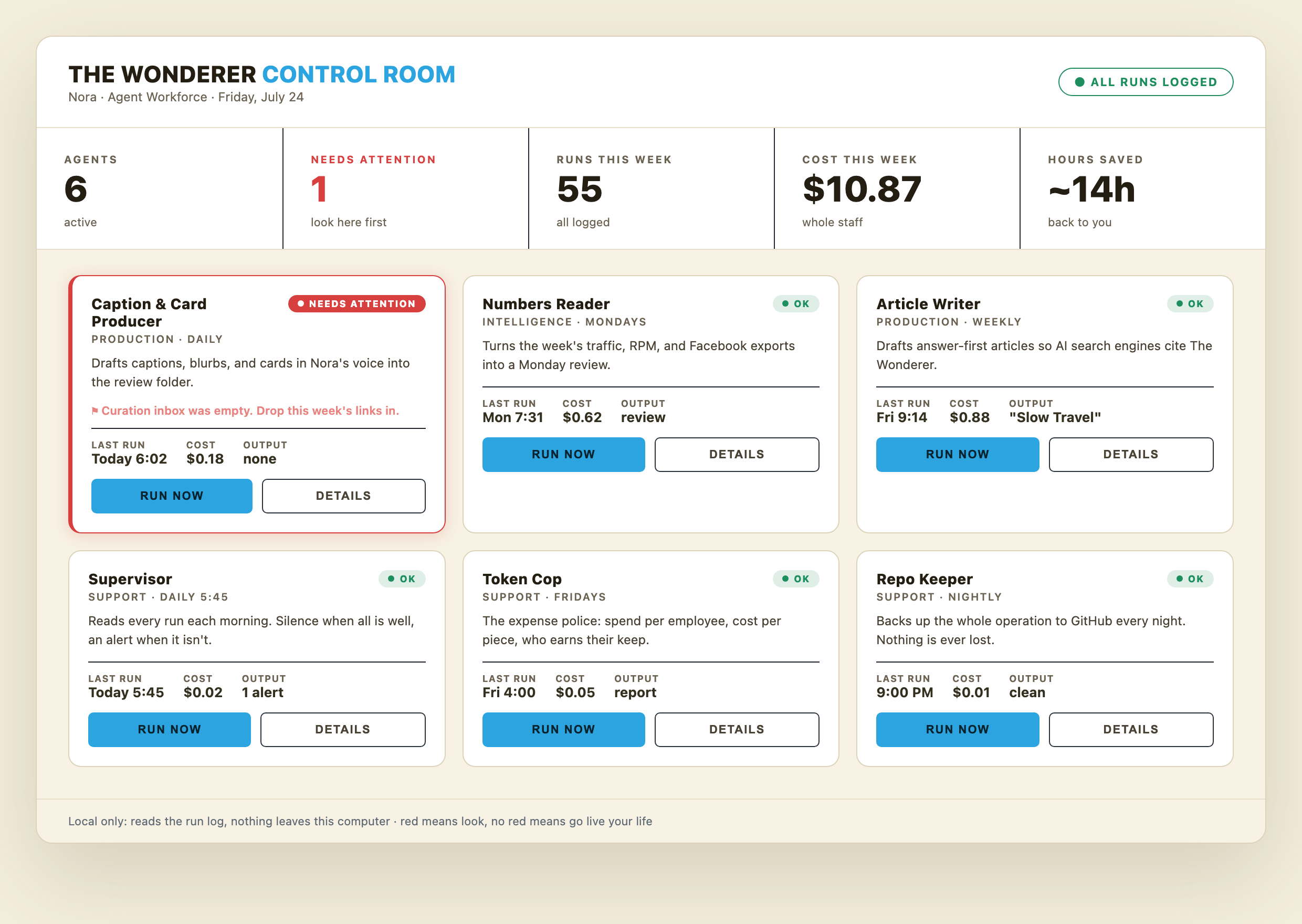
Everyone else describes what you'll get. Here is the thing itself, on a real publisher's computer. Red means look, no red means go live your life. Every employee is a tile: its job, its last run, its cost to the penny, and a Run Now button.

The Wonderer Control Room: six AI employees as tiles, each showing its job, last run, cost, and status, with one flagged in red and floated to the top.

A real Control Room, built in week two. Your business's name at the top; one tile needs a look, the rest are clear.

The part that matters most

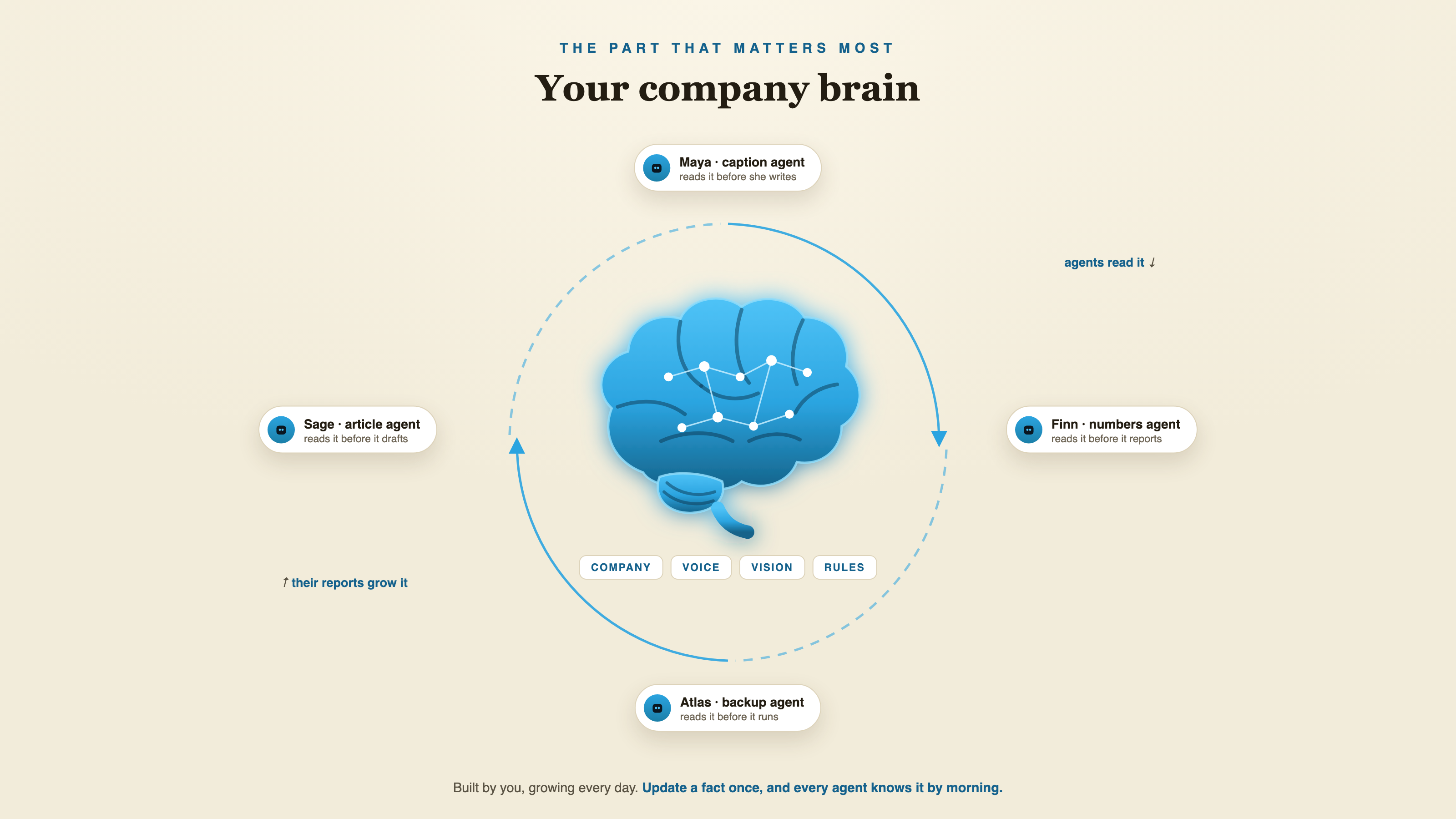
Underneath the Control Room is your company brain.

Everything you carry around in your head, the things only you know, finally lives in one place. How the business makes money. How you sound. Where you are going, and what you refuse to do to get there. The lines nobody may ever cross. You build it by answering questions, and it grows a little more every day, with every report your agents run. This is not a template. The brain is built from your business, its model, its voice, its rules, its hard lines, and every employee runs on it and on nothing else.

Your company brain: a glowing brain in a feedback loop with four agents around it. Agents read it before they act, and their reports grow it. Four files inside: Company, Voice, Vision, Rules.

Update a fact once, and every employee knows it by morning.

So you stop being the one who holds it all together. You stop being the go-to for every problem and every answer. Your business stops living only in your head.

You multiplied everything except yourself

You built the audience. You added the revenue. You never multiplied you.

Every publisher builds the first two multipliers. The third one is why growth stopped: there is still exactly one of you, and every task still routes through your hands. The downloading, the reformatting, the captions, the one-by-one that eats your evenings. Tools made those tasks faster. Nothing ever made a task disappear.

This does. Not by making you technical, and not by replacing a single person. We did not replace anyone at Publisher In a Box. We replaced the grind.

Why it is worth more in month six

Everyone else sells you context once. This one keeps learning.

Buy a tool and it is exactly as good on day three hundred as it was on day one. That is the deal everywhere else: you brief it, and then you keep re-briefing it, forever. Here, four things happen on every single run, and together they are the reason the thing you own gets better while you use it.

It reports on itself

Before it starts, an employee writes down what it was asked to do. It reports back on each item, and the verdict comes from the worst one. Nine of ten done is partial, and it names the one it missed. No employee here gets to mark its own homework.

It gets checked

Nothing reaches you unchecked. It stops and flags rather than guessing, and where the work needs it, a second employee verifies the facts against real sources and hands the work back rather than quietly fixing it.

It learns from your correction

When you mark something wrong, the fix goes into the employee's instructions, not just that one output. It keeps the graded work as its own report card. You should be editing less every week, and the things you stop having to fix are the things it has learned.

It feeds your brain

Every run asks one more question: did I just learn something durable about this business? A number that changed, a page that got renamed, a rule you stated. If yes, it proposes it. Your morning report asks you yes or no in plain English. Nothing edits your brain on its own, ever.

So a fact you correct once is known by every employee by morning, and an instruction you give once never has to be given again. The knowledge base grows out of the work itself, and it belongs to your business, not to us.

Here is the failure this exists to prevent, and it is the one nobody warns you about. Agents get installed against a snapshot of the business taken on day one. The business moves, as businesses do. Within a month every employee is confidently wrong, and nothing announces it. The work keeps arriving and it keeps looking fine.

What it actually feels like

Your Tuesday, once the team is running.

No "while you sleep" hype, no invented numbers. Just what a normal Tuesday looks like when the grind is off your plate.

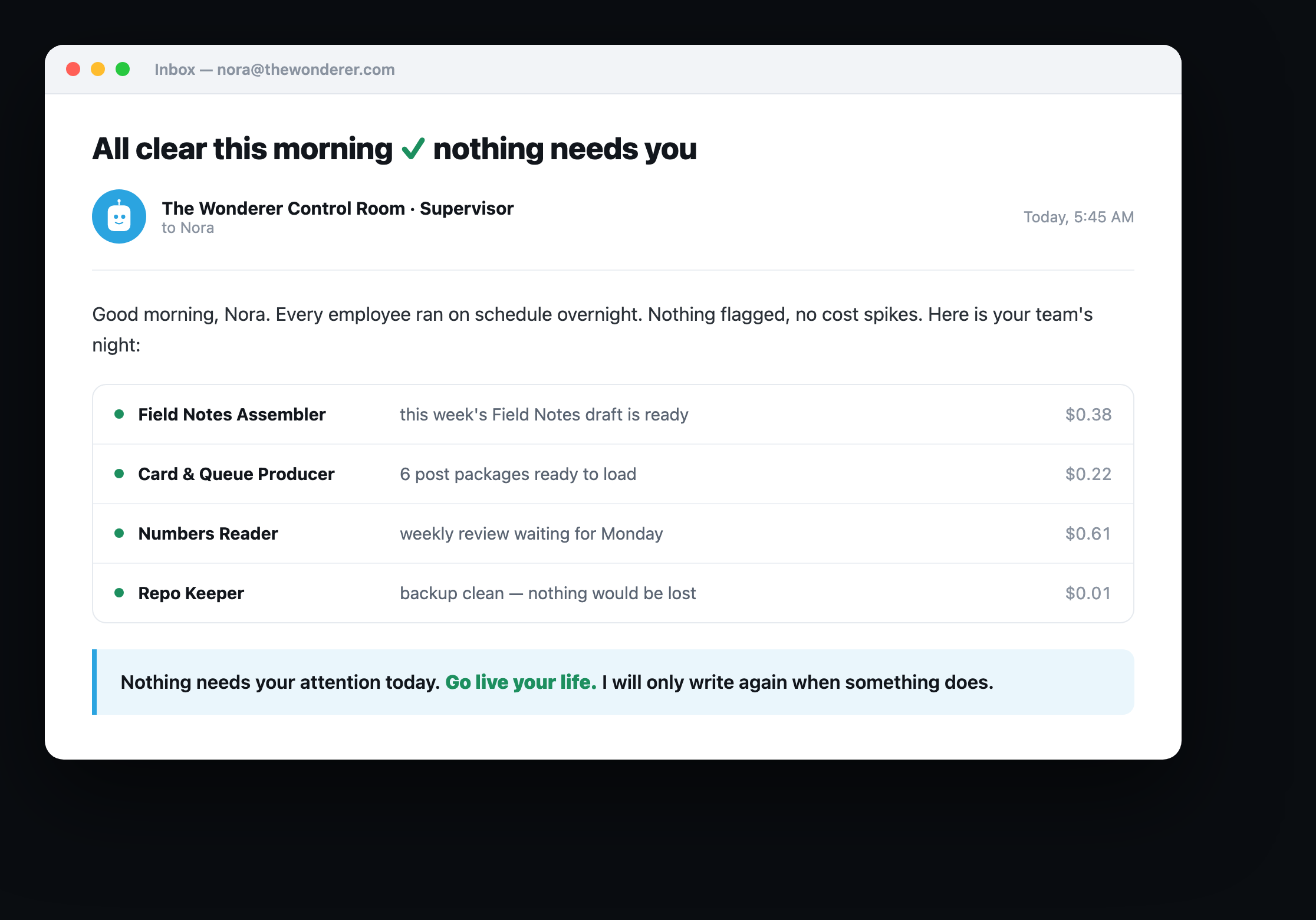
A 5:45 AM email from the Control Room Supervisor: all clear, four employees ran overnight with their output and cost, ending with go live your life.
Overnight

Your team already worked.

Captions drafted, the newsletter assembled, the backup run. You were asleep.

5:45 AM

One report, above.

All clear, or the single thing that needs you. It comes from your Control Room's Supervisor, not from us. You read it in the time it takes to pour coffee.

9:00 AM

You open your review folder.

Pick a card, tweak a word, load your posts. Twenty minutes, not an evening.

2:00 PM

Laptop closed.

You go to the thing you keep missing. The business keeps running, and your page still sounds like you, because you approved every word.

Two businesses, same revenue

The old way. The Control Room. Pick one.

The old way

  • You hire a person for every new problem, and margin leaks every time
  • The business stops moving the moment you stop pushing it
  • Your best hours go to admin a $15/hr VA could do
  • You are the answer to every question and the holdup on every task
  • You doubled your traffic and doubled your evenings at the desk

The Control Room

  • The repetitive work comes off your plate for pennies a piece
  • It runs whether you are in it or not, weekends included
  • Your best hours go to the decisions and the voice only you have
  • Your team reads the morning report instead of waiting on you
  • You doubled your traffic and got your evenings back
Why most companies fail at this

Agents do not fail companies. Operations fail agents.

Here is the part almost everyone selling AI skips. The reason most companies fail at implementing agents is not the AI. It is that the company was never operationally sound to begin with. Agents are task workers: point one at a vague instruction with wide permissions and it will do exactly what AI does, problem-solve, straight off a cliff. That is every rogue agent story you have read. Operations is the lifeblood of agent implementation.

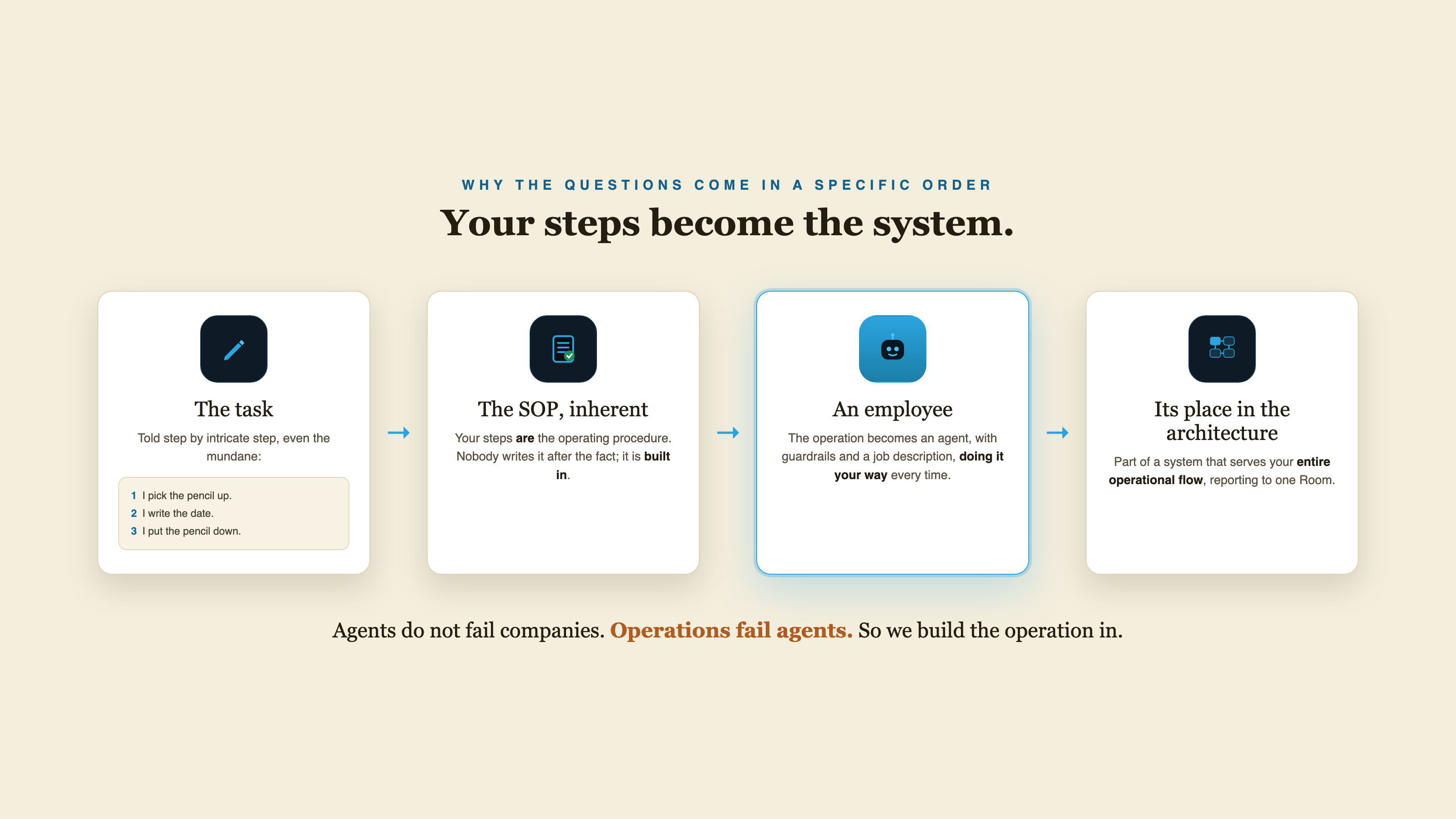
Now the part they really skip: you do not have to be operationally sound before you start. The fix is in how the questions get asked, in a specific order, down to the mundane. What do you do to accomplish that task? I pick the pencil up off the table. I write the date. I put the pencil down. Every intricate step creates the flow, and because your first employee is built from those steps, the standard operating procedure is inherent. Nobody writes an SOP after the fact. The employee ships with it built in, because it was built from your way of doing the work.

That is the ladder this whole system climbs: an operation becomes an employee, the employee becomes part of a system, and the system serves your entire operational flow, every employee in its place in the architecture. You come out the other side with more than a team. You come out with a company that finally knows, in writing, how it runs.

Four step flow: the task told step by step, the SOP inherent in those steps, the employee built from them, and its place in the company architecture.

The order of the questions is the method. Your steps become the SOP, the SOP becomes the employee, the employee takes its place in the architecture.

How it is built, in order

Three stages. The order is the whole point.

1

The Foundation: your company brain

Before anything gets built, the system learns your company: who you are, what you own, where the money comes from, how you sound, your hard lines. That becomes your company brain, and every employee reads it before it does anything. My team drafts most of it for you before day one, so you correct and approve instead of filling out homework.

2

The Architecture

The structure that makes automation safe before any automation exists: your operation backing itself up nightly, review folders where all work lands as drafts, rules no employee can cross, and approval gates with you behind them. You have read the horror stories about AI agents deleting files and going rogue. Those agents had no job description, unlimited permissions, and nobody watching. Yours draft, log, and stop to ask. Structure first, employees second.

3

The Analysis, then your team

We find your most repetitive work and break it into steps. Your biggest burden becomes your first employee's job description. You approve it, it gets built and tested on your real work while you grade it. Then the next hire, then analysts that read your numbers and show you where you actually win, and a manager that watches them all. A team, in your Control Room.

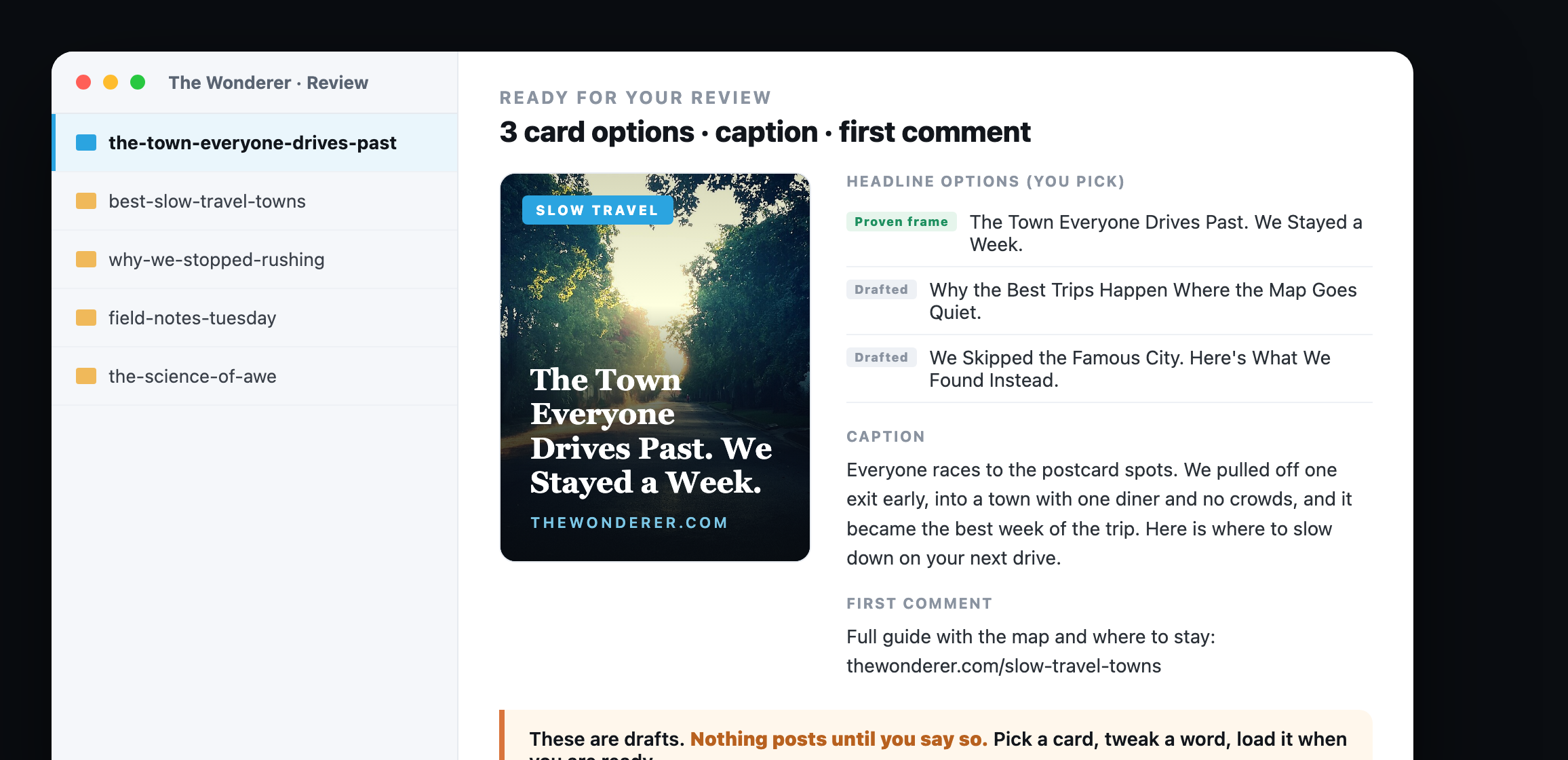
A Review folder holding finished post packages: a rendered card, three headline options tagged proven or drafted, a caption, and a first comment, all marked drafts.

What lands in your review folder: finished packages, drafts only. You pick the card, tweak a word, and nothing posts until you say so.

Under the hood, in plain English

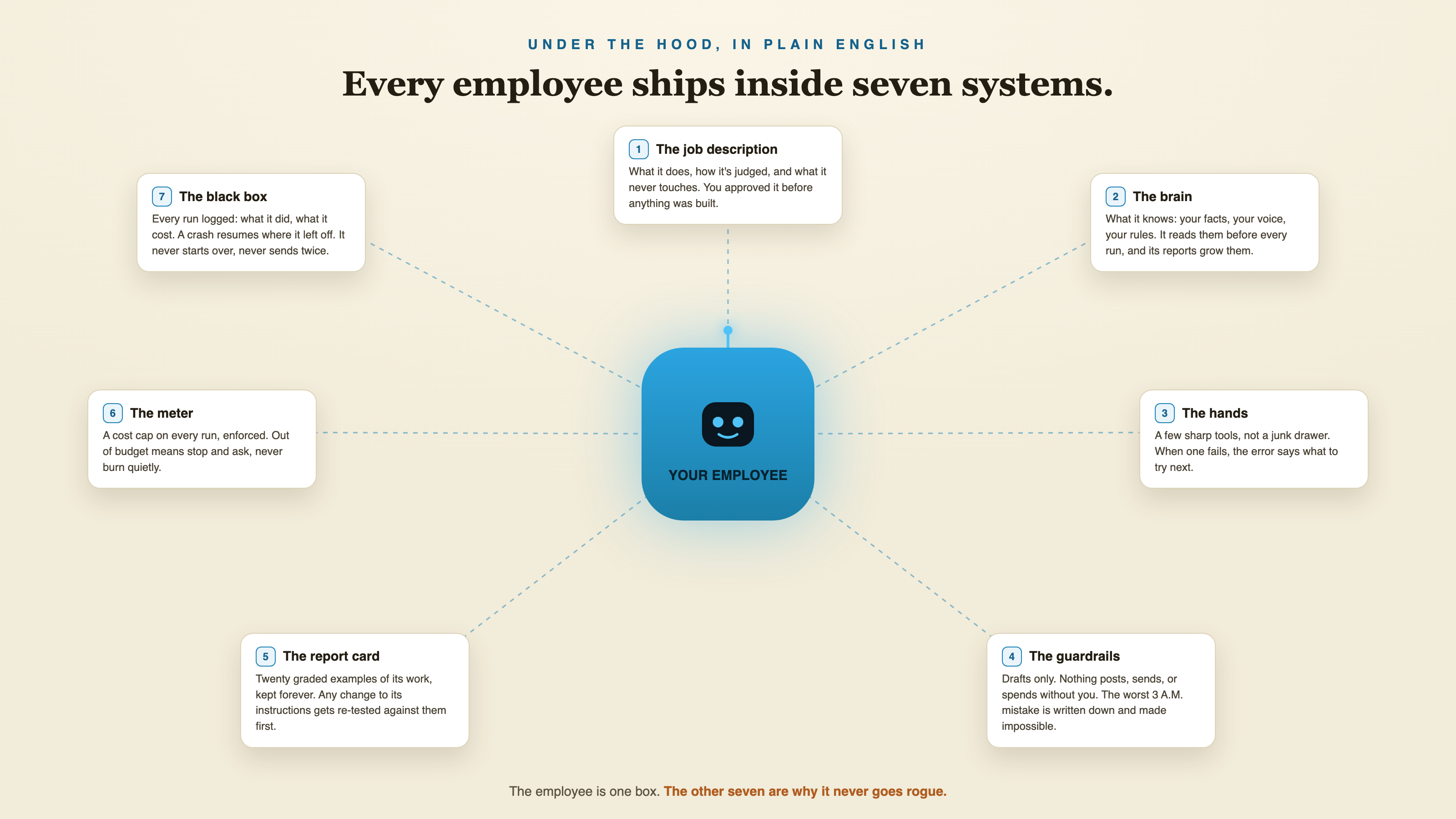
Every employee ships inside seven systems.

This is the architecture you are buying, without the jargon. The employee itself is one box. The other seven are the reason it drafts instead of posts, stops instead of guesses, resumes instead of restarts, and asks instead of burning money. Most agent failures you have read about are one of these seven missing. I call the seven, together, the spine: every employee is built on it, and an agent built without a spine is the one that goes rogue.

Seven systems around one employee: the job description, the brain, the hands, the guardrails, the report card, the meter, and the black box.

The employee is one box. The other seven are the spine, and the spine is why it never goes rogue.

The outputs, not the promises

What actually lands in your review folder.

Skip the video if you like. This is the work itself, from a real publisher's Control Room: read it the way you will every morning, with coffee, saying yes or tweaking a word.

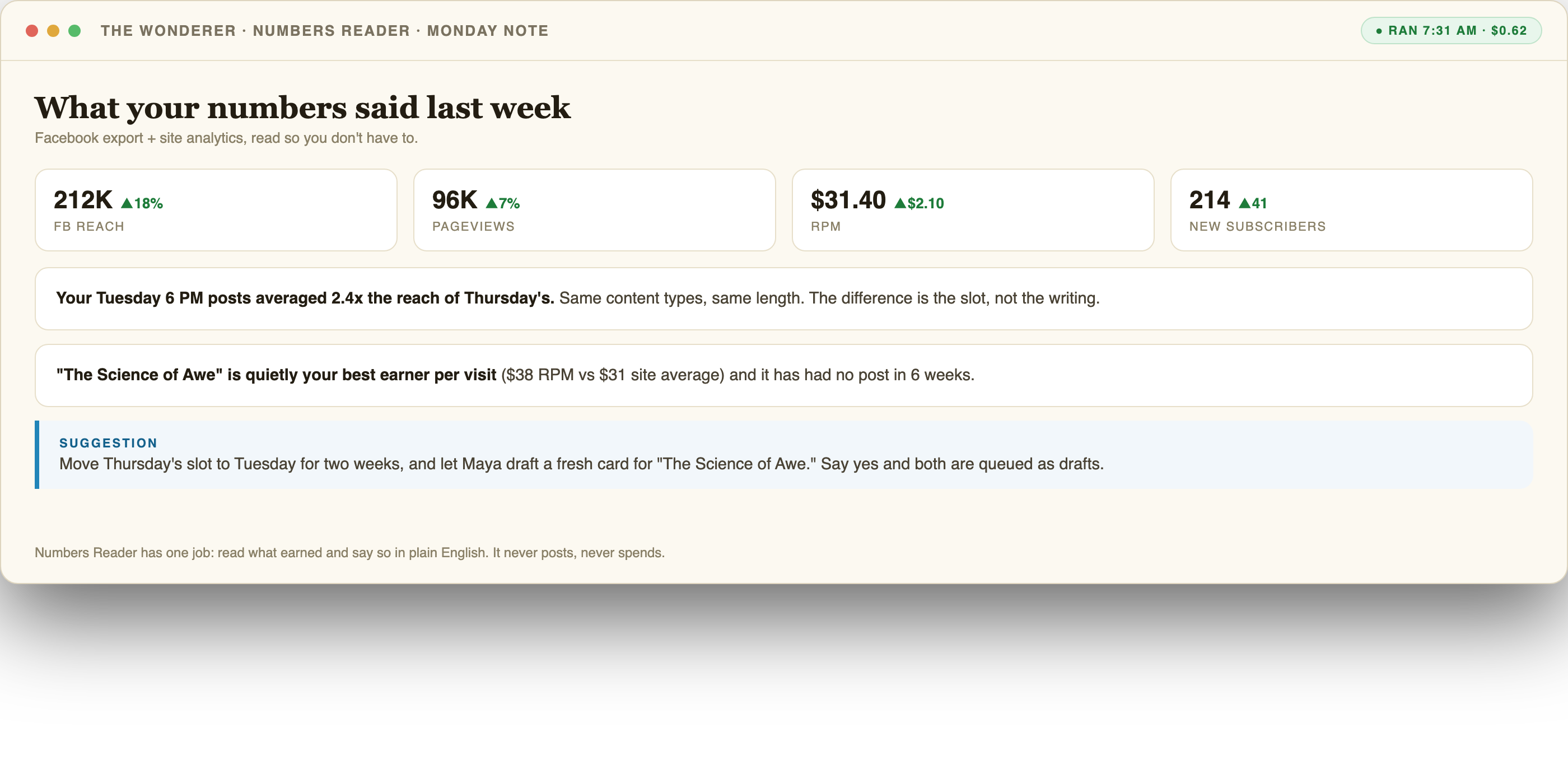
A Monday note from the Numbers Reader: reach, pageviews, RPM and subscriber stats with two plain-English insights and one suggestion, ran at 7:31 AM for $0.62.

Monday, 7:31 AM: your Facebook and site numbers, read to you, with a suggestion you can approve in one word.

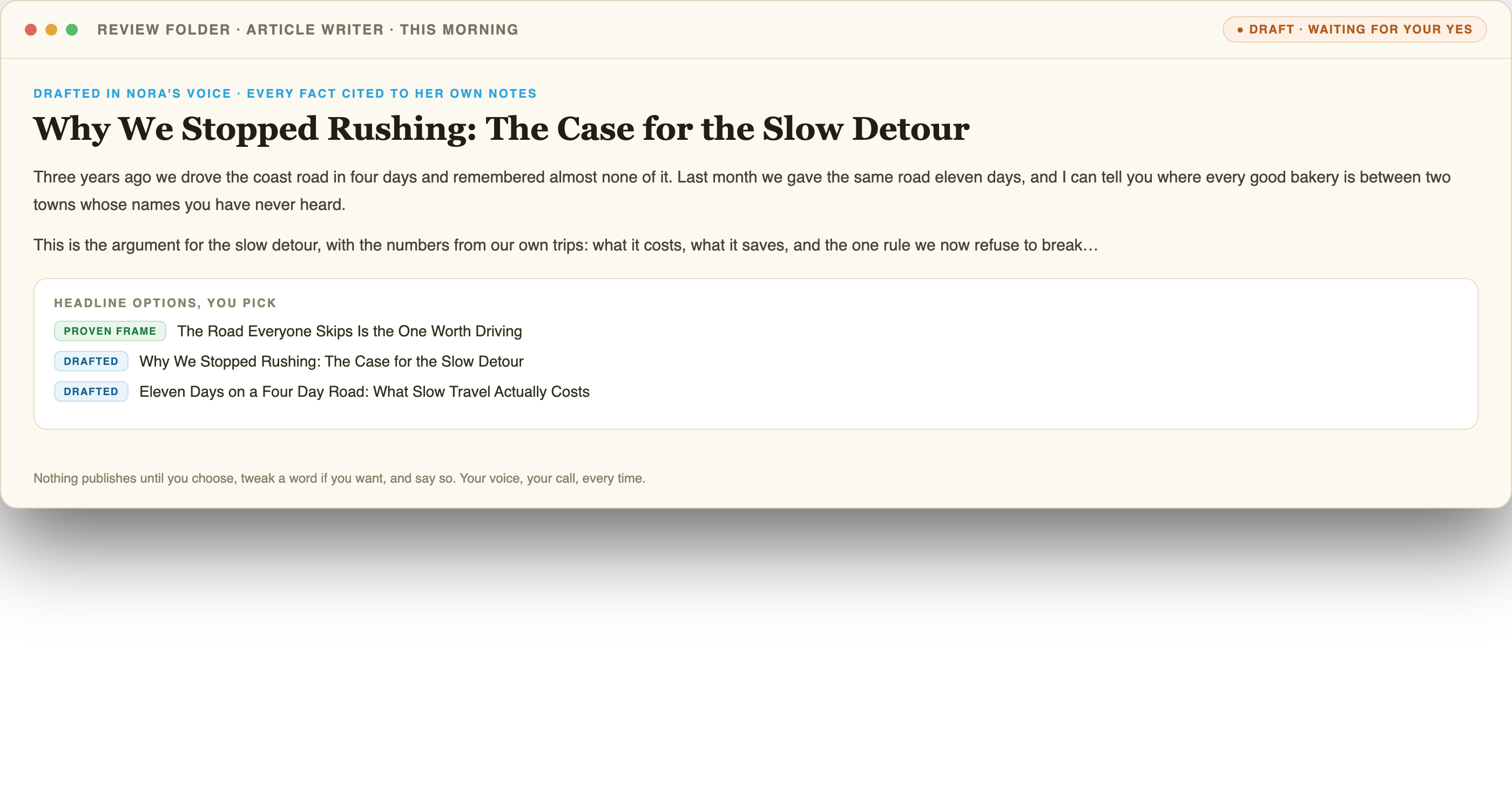
A drafted article in the review folder titled Why We Stopped Rushing, written in the owner's voice, with three headline options tagged proven frame or drafted.

An article drafted in your voice with headline options, waiting for your yes. Nothing publishes without you.

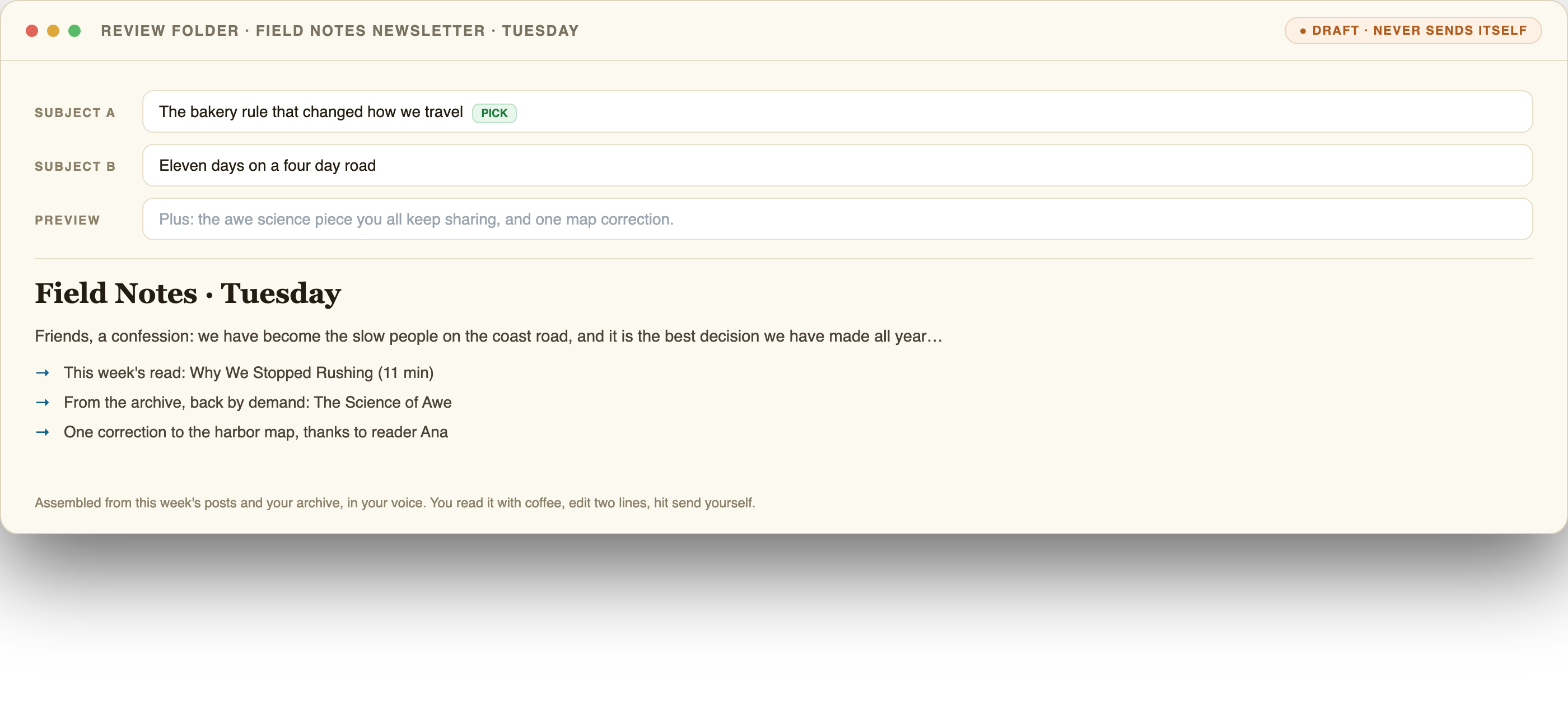
A drafted newsletter with two subject line options and a preview line, assembled from the week's posts, marked draft, never sends itself.

Tuesday's newsletter, assembled from your week: pick a subject line, edit two lines, hit send yourself.

The money works twice

Save on one side. Optimize on the other.

The expense side

An AI employee does the task work for pennies. Our production agents run at under $0.25 per finished piece. Compare that to your hours, a VA, or one more $99 tool subscription you barely use. The busywork comes off your plate and off your budget.

The revenue side

Once the busywork is gone, the deep-dive employees read your numbers and show you where you actually earn: which content pays, which platform pays, where your next hour is worth the most. That is where ROI stops being a guess. Both sides compound, because every correction you make, your employees keep forever.

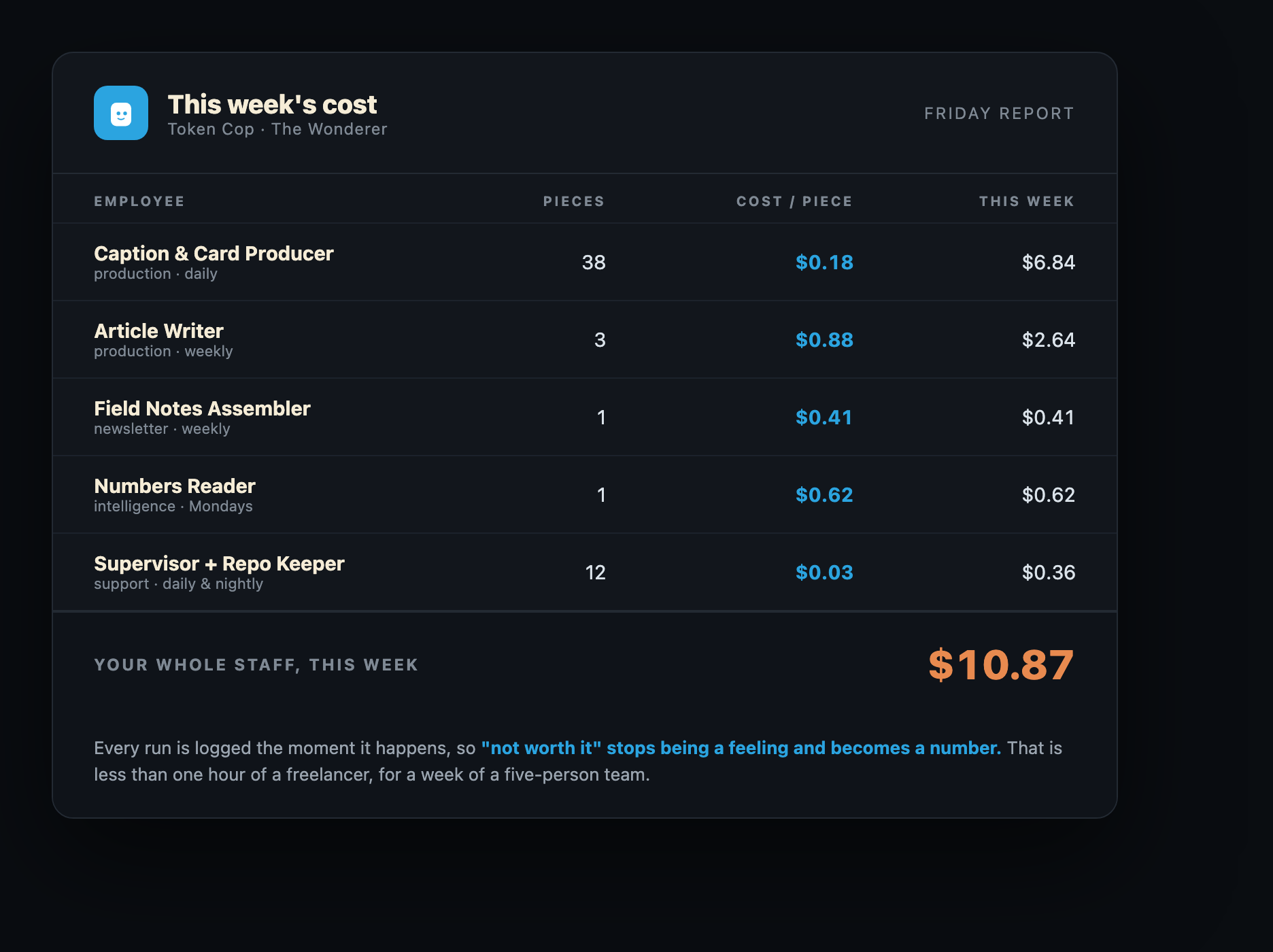
A Friday cost report from the Token Cop: each employee, pieces produced, cost per piece, and the week total of $10.87 for a five-person staff.

Your Friday cost report, every run logged to the penny.

A freelancer costs more in one hour than your whole staff costs in a week. The question stops being "what can I afford to hire" and becomes "what do I want my evenings back for."

Your six weeks

One call to start. One group call a week. Email in between.

Claim your seat and take the onboarding call.

One call covers it: setup, the interview that finds your first employee, and onboarding. Every answer becomes fuel your employees run on, and my team goes to work on your plan the same day.

Your packages arrive.

You receive your Agent Package and your Control Room Package and start running them on your own laptop with Claude. We evaluate the company and recommend where to build first.

One group call a week, for six weeks.

All ten of us, once a week. Between calls I work with you over email through the week to keep the ball moving: interactive, not scheduled. A small group of the other nine.

Your Control Room goes up.

A real employee doing work you graded, backups running nightly, a manager watching every morning, and one dashboard with your name on it. You did none of the technical work. And you leave with a repeatable method: identify the next employee, read its job description, build it yourself, after the group ends.

Who this is for

Established publishers, not beginners.

This is you if

  • You have at least one property that earns real money
  • Your week is full of repetitive work that runs through your hands
  • You have multiple revenue streams, or you are building toward them
  • You are a smart operator who does not want to become technical
  • You have hit a ceiling and know tools alone will not lift it

Not the right fit if

  • You just opened your first page and have no revenue yet
  • You want to become a prompt engineer. You will learn to build employees on the spine; you will not learn to write code
  • You are looking for done-for-you with no involvement
  • You cannot give six weeks a few hours each
Why $5,000

The working system, at a founding price.

AI education for business owners sells at $9,000 and up. I have sat in those programs. The cheap ticket gets you three days of theory; the working system is the upsell, and the upsell is five figures.

This founding group is the working system. You do not leave with one agent. You leave with a staff: the foundation employees that run underneath everything, the first employee we build together on your real work, the architecture around it, and your Control Room on your screen. My consulting clients pay $8,000 for one to one work and my time is the bottleneck. This group gets the same architecture at half that, because the product does the heavy lifting and the group carries the teaching. $5,000 is the founding price for these ten. After this group it goes to $10,000, because by then it will have ten proofs that it works.

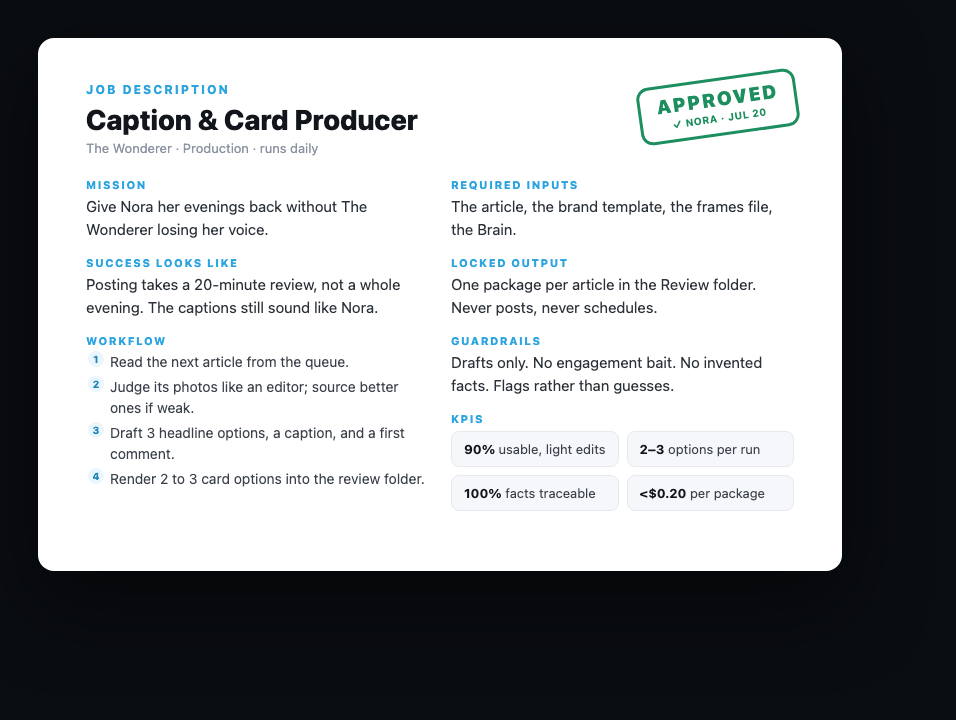
A job description for the Caption and Card Producer with an Approved stamp signed by the owner: mission, success, workflow, guardrails, and KPIs.

You do not write these. You read them like a manager and say one word: approved. Nothing gets built before you do.

An honest note. Your employees draft; you decide. Nothing here posts, sends, spends, or deletes on its own, ever. You do none of the technical work, but you are the boss at every step: you read the job descriptions, you say approved, and nothing leaves your computer without you.

The Setup Guarantee

Show up. Put the work in. Try it. If by the end of week two your system still is not running on your own machine, with our help in the group, we refund you in full and part as friends. The risk of setup is on us. If you do not show up, there is no refund.

Ten seats. When they are gone, the next group pays more, because by then it will have ten Control Rooms that prove it works.
Questions

Fair questions, straight answers

Do I need to be technical?

No. Your assistant builds, runs, and houses everything. You describe what you want in plain English, read what comes back, and say yes or no. If you can write a message in a group chat, you are qualified. That is the whole promise: you never have to know the right question, you just describe your problem.

What do I need to have ready?

A computer (Mac or Windows), a paid Claude plan (about $20 to $200 a month depending on tier; think of it as payroll, not a software subscription), and real repetitive work worth removing. We walk you through the rest in the first two days.

Is it safe? I have read the horror stories.

Those agents had no job description, unlimited permissions, and nobody watching. They did what AI does: they problem-solved, with no boundaries. Ours are built as employees. Every one drafts into a review folder, logs what it did and what it cost, and stops to flag you rather than guess. Posting, sending, spending, and deleting are not restricted here; they are absent.

How much of my time does it take?

Roughly a few hours a week for six weeks. One weekly group call, plus email support from me through the week, and a small group chat with me in it regularly.

What if I fall behind?

The group moves together, but the material waits for you. You keep your entire operation forever; there is no subscription to the system itself. And you leave with the skill to keep hiring new employees long after the programme ends.

Ten seats. One founding price. Once.

By the end you will have the architecture, a real AI staff and a Control Room with your business's name on it, on your own computer. You have seen the actual product on this page, not a promise of it. Remove the tasks first. Optimize and create from the hours you get back.

Claim a Founding Seat for $5,000
Have a code? Add it at checkout. Setup guaranteed by week two, if you do the work, or your money back.
Read “Who this is for” before you claim a seat.